Monday, July 18, 2011

Post the Eleventh: C'Mon N Ride It (Dandong 1 of 5)

The view of North Korea across the Yalu River.

"Dandong (simplified Chinese: 丹东, pinyin: dan1dong1), previously known as Andong and Antung, is a city in Liaoning Province, Northeast China. It lies on the border between China and North Korea, which is marked by the Yalu River, and is the largest border city in China."
~ Wikipedia, keyword: Dandong

The Sino-Korea Friendship Bridge leading from Dandong to Sinuiju, DPRK.

Salutations! I am back from a fantastic weekend trip to Dandong in Liaoning Province. Because the trip included a variety of activities (and also because I have hundreds of photos), I've decided to split this post into five (whoa there, 魏德, calm down!) posts, otherwise I wouldn't truly do justice to the city of Dandong and the travel experience as a whole.

Part I: Trains
A small Chinese town in the countryside of Jilin.
There are many options for transportation within China ranging from the lowly tour bus to the regal (and sometimes questionably safe) airplane. The most cost-efficient means of travel, however, is the train: for very little money, one can travel from northern China to southern china in a day or so. Chinese trains come in different types, sizes/lengths, and speeds (they've a new 300 km/h bullet train  that runs between Beijing and Hong Kong if you're looking to empty your bank account). One thing that doesn't change is the accommodation options. Every train has at least four of the following five "classes": soft-sleeper (luxurious compartments with doors and air-conditioning with four bunks, each bunk with its own light and super-soft mattress), hard-sleeper (sturdy six-bunk compartments sans doors and air conditioning for the entire car), hard-seater (barely cushioned straight-back benches of four or six in a non air-conditioned car full of standing people), soft-seater (reclining cushioned seats of three or four with no standing people), and standing (your body is allowed to be on the train - that's about all).

China is a developing country, which means that buying train tickets is a full-blown nightmare since there isn't an online system (only time I've ever missed Amtrak) and you have to wait in lines years long in order to ask the grumpy attendant behind the window for a ticket only to find out that all the trains going to your destination are sold out for the next two weeks. Two weeks ago, two fellow Yalies and I went to the on-campus train ticket shop to purchase tickets to Dandong. We stood in line for about half an hour in a room averaging about 95 degrees before getting to the window where we learned that tickets for July 14th weren't on sale until the next day. SAGNIDGMSKLDG. One of the Yalies and I went back the second day at 8:15AM and stood in line for over an hour in an non air-conditioned dark staircase to purchase six hard-seater tickets to Dandong (there wasn't anything else available) for 55 kuai (plus a 5 kuai service-charge) apiece. Three days later, we went back and stood in line for another hour behind a man who obviously had been to the gym earlier that day and obviously had neither showered nor applied deodorant. We managed to get hard-seater tickets from Dandong to Harbin East Station (see SKETCHY) for July 17th for the same price. Overall we spent less than 20 USD on 1132 kilometers of travel. Not too shabby.

Oh wait, JUST KIDDING. The day (or rather, night since it was 9PM) of departure, the six of us arrived at the Harbin (regular) train station an hour and a half before our train left. We got to the terminal to find that our train wasn't posted yet. After waiting an hour, our train finally appeared about 15 minutes before it was supposed to start boarding. We waited 30 minutes. Then 10 more minutes. Then the board with our train information changed to say that the train was slightly delayed, but it would be there soon. Soon turned into 5 minutes, then 10 minutes, 20 minutes, 30 minutes. The Chinese people around us began muttering amongst themselves as time ticked on and other trains came and went. Finally our train disappeared all together. No one moved from line, though everyone panicked. Then it reappeared and guards came to unlock the gates to let us board. But then they decided it wasn't time yet and made us stand in line for another 10 minutes. During those 10 minutes I was slowly flattened between my fellow Yalie and a tiny Chinese woman as the crowd slowly surged forward against the closed barrier. Finally, they opened the gate and we all dashed to the platform.

Once we arrived at the train, we immediately tried to upgrade to soft-seater, hard-sleeper, anything they had. We were rebuffed at once - the train was sold out. We made our way to the hard-seater car and were appalled: the car was PACKED with sweaty Chinese men, women, and children sitting in seats, on seat-backs, on stools, on the floor, EVERYWHERE. The fans on the ceiling did nothing to abate the sweltering yuck in the air. We managed to trip our way to our seats (Chinese eyes following the crazy 外国人 foreigners the entire time) to find that not only were they already full, there was also a woman sitting on a self-provided stool in the space between the seats. After graciously kicking out the squatters, we sat down and the stool-woman sat back down in our aisle. We all looked at each other and then at her. She looked at us and then turned to the man squatting in the aisle and wondered aloud who we were. She wasn't moving. Great, I wasn't planning on using my legs anyway.
Our train car on the way back. I don't have any pictures from the ride to Dandong since it was too crowded for me to access my camera.
This is my favorite: you're busy talking to your friends when suddenly someone's bottom appears next to your face.
Luckily the train back to Harbin East Station didn't get more crowded than this.
The train finally began to move and the breeze in the open window successfully fought back the heat in the train car. We conversed amongst ourselves, much to the fascination and entertainment of our fellow travelers who crowded the aisle to watch us speak. Every now and then they would interrupt our conversation to ask where we were from, where we were going, and why on EARTH did we pick hard-seater. The stool-woman gradually began taking it upon herself to answer these questions for us, as well as add her own commentary (e.g. she couldn't believe we chose Dandong as a vacation spot, didn't we know better?).

At around the fifth hour (of thirteen), confrontation finally arrived. Stool-woman attempted to climb up our bench to sit on the seat-back like others around her. You wish, lady.

"What do you think you're doing?"
"I'm going to sit up here because it's too hot down here."
"These are our seats."
"Look, they're doing it."
"But these are our seats!"
"Everyone else is doing it," she said, proceeding to climb up. Everyone on the car was watching this exchange as if it were a TV program. At that moment, I decided to make a stand.
"Not cool. You cannot sit there."
"Why not?"
"These are our seats. We paid for them."
"I'm just going to sit up here."
"Okay, well we paid for these seats, so every part of them is ours, including the seat top. My friend has already told you that you can't sit there, so come down. Now."
"But everyone else is-"
"I don't care if everyone else is sitting up there, we paid for these hard-seats, so we may do what we like with them. You have a standing ticket, not a seat-ticket, therefore you may not sit here. Is that clear?"
"I'm sitting here."
"No, you are not. Come down, now!"
"Just a minute-"
"I said come down! Right now!"

She came down. I glared at her before waving away thanks from my companions. For the three hours before she left the train, she did not engage us in conversation nor did we her.

At that moment (and afterward), I felt many feelings. One was fury at being scoffed by a woman for over four hours and then being expected to provide her with a seat (oh, the nerve!). One was guilt at becoming so angry over a smallish matter (though at the time, the car's temperature persuaded us that adding a body to our already cramped seat bench was not a good idea). Another was pride at successfully winning an argument in Chinese with a Chinese person. The last one was discomfort at having used my Chinese abilities for what I felt was nothing more than selfishness and evil.

As it turns out, Americans and Chinese have different ideas of what these tickets mean. In the US, a ticket with an assigned seat means that the owner of the ticket is granted possession of the entirety of the seat; no other person may use it in any way, shape, or form. In China, a ticket with an assigned seat means that you have purchased the right to sit down in the general area of your assigned seat. If someone wants to sit on your seat back, that's okay. If you get up to go to the bathroom or if you haven't yet boarded the train, they may sit in that seat until the ticket-holder returns and demands (with ticket in hand) their seat.

ANYWAYS, thirteen hours (and numerous leg-cramps, stares from Chinese, neck-breaking naps, etc) later, we arrived in Dandong at 10AM.
We had our own personal greeter when we stepped out of the Dandong train station. That's Mao, by the way.
Dandong train station, Dandong.
Our hotel, which had the comfiest beds ever.
Sign marking the Yalu River. North Korea is just across the river.
End Part I

Thursday, July 14, 2011

Post the Tenth: Ceremonies Galore

Yeah, I have no idea either.

Another busy week!

  • Huizu Wedding: My composition teacher got married last Sunday (well, actually she's been married for several months but the celebration was on Sunday) and invited us to attend the ceremony. I knew it would be a good time when the ceremony host walked into the room to "He's a Pirate" by Klaus Badelt (the Pirates of the Caribbean Theme). It was a lively and atypical affair: my teacher is Huizu, a type of Muslim ethnic minority in China, so the ceremony was split into a Hui portion and a more traditional Han-esque part. The first portion featured several Imams who led the service in a combination of Mandarin and Arabic prayers, traditional Huizu costume (my teacher looked gorgeous by the way, so be jealous), and the throwing of candy and other assorted treats at guests (this was really fun until a large unidentifiable nut-object landed in my drink). During the second half, the bride and groom returned in Western style clothing, received gifts and blessings of matrimonial happiness from their parents and friends, and took photos with guests. Overall, the experience was exciting and unlike anything I had ever experienced before in my life (my Han Chinese teachers also found the ceremony fascinating since it wasn't typical Hanzu). Clearly a cooler way to spend a Sunday morning than doing homework.
Outside the restaurant, which turned out to be a decoy for the real one that was on a different street. Good job, Google Maps.
One of the imams/the main MC for the wedding. The groom could not be more uncomfortable. His cell phone rang twice during the ceremony. That would NEVER happen in the US. EVER.
There were probably around 100 friends and family at the event. Oh yeah, there were some foreigners there too. I almost forgot, except they kept welcoming us every five minutes (cue round of applause).
My teacher in a Western wedding dress. She's so pretty!!
The food was obviously delicious. (No, it isn't boneless)
  • Tea Ceremony: This afternoon our 1-on-2 teachers took the CET students to a tea house to learn how to pour, drink, and otherwise appreciate Chinese tea. Each group of four or five (four students plus a teacher) sat around a table while a qipao-wearing xiaojie (see young & pretty Chinese woman) poured tea and told us the names of the billion tools used in the ceremony (I couldn't name a single one if my life depended on it). Though the room was a bit toasty for drinking hot tea, the tea itself was delicious (as were the snacks of peanuts glazed in seaweed) and gave off a soothing aroma. Each student then took their turn pao-ing (preparing and serving) the tea. The procedure is not that complicated, yet each one of us managed to mess up at some point and some of us (see ME) even managed to burn our fingers on the teapot.
Teapot, teacup, big bowl for holding teacups, a big wooden thing full of tea-serving related tools, and tea snacks. 
My 1v2 Chinese teacher pouring tea. She's a pro.
Tonight, while most of CET rests for their 6AM departure to Yichun, six of us will be en route to Dandong, a city on the Yalu River. This city is awesome because 1) it's near the Eastern terminus of the Great Wall, 2) it has a museum retelling to Korean War from the Chinese perspective (they were victorious and they are going to tell you about it), and 3) North Korea is on the other side of the river. How will we be arriving? 13 hours of hard-seater train, of course. No air conditioning, no breathing room (in a country that doesn't use deodorant), Chinese tourists as travel companions. Adventure time? Check yes.
We should've asked this guy to take us to Dandong.

Packpackpackpackpackpackpack!

魏德

Saturday, July 9, 2011

Post the Ninth: It's Grrrrrreat!

Meet Panthera tigris. Chinese: 老虎, tiger.
Having spent the past several hours looking at classes for the next two semesters, I am quite glad to take a break. This weekend has been quite eventful. Some thoughts:
  • You Drive Me Carzy (Crazy): A CET classmate turned 21 yesterday so we went to KTV (karaoke) last night to celebrate properly. Name of the establishment? Baby Gaga. The four story building was decked out in ultra modern (see Ikea) furniture and fixings: mirrors lined the walls and reflected flashy music videos shown on ceiling-mounted TV sets while huge glass beads hung from every possible fixture. The walls that weren't covered in mirrors showed many pictures of Lady-Gaga lookalikes in get-ups that Gaga Xiaojie would undoubtedly wear. Unclear if Ms. Gaga knows that she has her own karaoke joint in Harbin, China; as the place hasn't been closed down for blatant intellectual property rights violations, I'm going to go ahead and guess not. Anyways, it was a fun experience, especially for our Justin Bieber-loving neighbors (again, unclear how a group of ten 30-somethings knew every word to "Somebody to Love").
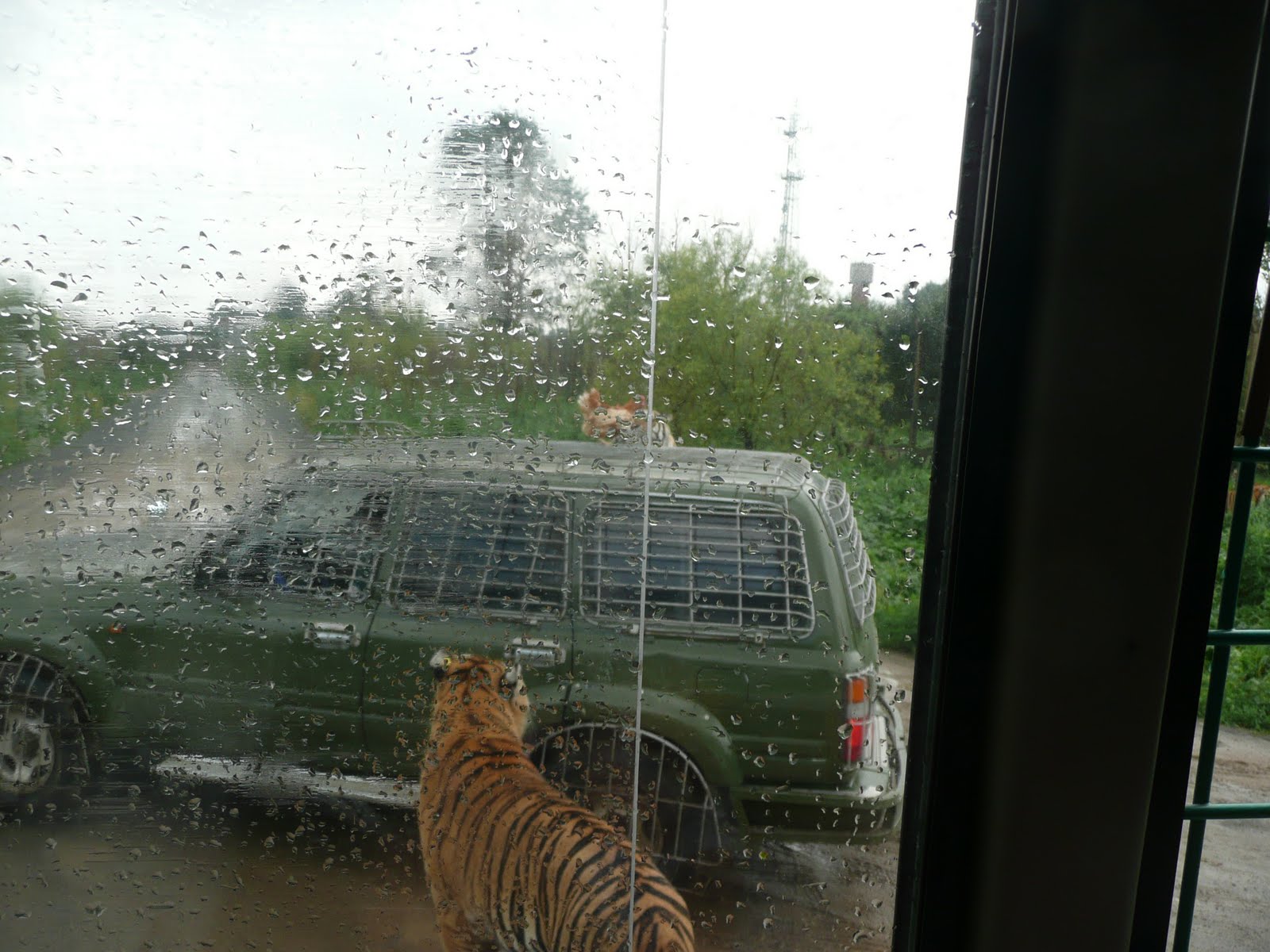
  • Siberian Tiger Park: I don't care what you're doing this summer or where you are doing it; your summer isn't as cool as the hour I just spent at the Tiger Park in Harbin. The park is a reserve for the first-class protected Siberian Tiger, an endangered species of feline that is almost extinct in the wild. This morning, a small group of us went to the park to go on their safari tour to see the tigers as well as some tiger-lion (liger!) crosses and other big cats. Unlike at other animal parks, the Tiger Park safari is a bit non-traditional: when purchasing their tickets, guests can also purchase chickens ($9), goats ($100), and cows (~$10000000000) to feed to the animals. Those of you who don't like animal cruelty or nature shows or watching things eat other things should probably skip to the next bullet point. Basically what happens is that each visitor is placed on a large safari bus (which is really a converted tour bus with the windows replaced by wire grates). If anyone on the bus bought something to feed the tigers, a large truck covered with metal plating and wire grates (see INTENSE) appears when the bus reaches the feeding area. The truck parks a short distance away from the tigers and the driver either a) shoves a chicken out of the window and onto the roof of the car or b) tips the back part of the truck to send a goat/cow sliding to the ground. A feeding frenzy ensues and, in the blink of an eye, the poor sacrificial animal has passed on to the next life via the maw of a tiger (or six). The whole process lasts about 30 seconds but it's probably the most exciting thing that's happened to me so far this summer. I had misgivings about going to the park since it's a little barbaric (purchasing undoubtedly mistreated livestock to sacrifice, cheering when the tiger kills its prey, taking pictures with a tiger cub while its mother freaks out nearby) and the show is really just a money-raising enterprise. On the other hand, the Siberian Tiger Park has reversed the decline of the cats and is helping to reintroduce them into the wild as a result of the funds pouring in, so you could also say the feeding is helping to fund the recovery of the tigers. I'll let you think about that while you look at some pictures.
One of the many tiger statues in the parking lot. The real ones are a lot scarier.
Mature tiger = FIERCE.
These were sleepy.

The king will see you now.
Oh, you know, just chillin' on some cigarette butts and plastic wraps that the Chinese tourists have kindly thrown down into my pen.
Here are some (well, one of each) before and after pictures of the chicken we purchased (out of 20 something people on a bus, leave it to the four Americans to pay money to kill an animal that we didn't eat ourselves).
WARNING: GRAPHIC
Before: note the chicken on top, the hungry tiger on the ground, and the intense cage things on the windows of the truck.

Next time, the tiger pays for OUR lunch.
Here is a hungry tiger being fed a piece of beef.


Here are some of the other big cats in the park.

One liger bathing another.
A liger licking its chops.
Sleeping liger. It looks a bit sick, doesn't it?
One lounging lion.

Overall, fun times. I just hope PETA doesn't hear about any of this.

My composition teacher gets married tomorrow morning! So excited!!!

魏德

Friday, July 8, 2011

Post the Eighth: The Health Edition

Greetings from the end of another hectic week! I promise I'll add some photos later (hopefully I'll have good ones after this weekend). I've just gotten my head back on so I only have two things but here they are anyway:
  •  I HATE bugs. You know what I really hate? Mosquitoes. You know what Harbin has a lot of? The little blood-suckers. My father's side of the family is known for being especially popular with the little devils and I, in keeping with family tradition, have inherited this trait. Yesterday at lunch I sat outside with a bunch of friends to eat. Everyone was wearing shorts and a T-shirt except for myself (full length pants and a button down shirt). Guess who got bitten on two knuckles (WHAT) and finger tip (WHY)? The three sites were beautifully swollen last night and I lost the use of my left hand due to itchy pain - I can tell you right now that I had no idea how much I used that hand until last night when suddenly every motion (including typing) became an histamine-induced hassle. Today I bought a Chinese bug bite ointment after class from my usual lunch haunt, the Special Flavored Food Market. The tiny little box housed an even smaller lipstick-sized tube, which was only half-filled with actual medicine. I'm pretty sure the stuff contains some derivative of morphine since all three bites AND the finger I used to apply the cream have gone completely numb. I guess that's better, right?
  • I joined a nearby gym the other day so I could use their dance studio to choreograph as well as fight the few new pounds of beef-fried-rice I've recently added. To help those of you in other areas of the world understand the Chinese gym, let my provide you with a visual. Imagine you are in an American gym but only half the lights are on. Also imagine that this gym has no air conditioning. There are two 200 pound Chinese men playing ping-pong in the corner while their 250 pound friend watches. They are all shirtless. None of them have anything closely resembling a six-pack. There are a couple bean-pole thin Chinese men lifting weights (or water bottles, I didn't have my contacts in) amongst a slim smattering of Russian expats (all of whom are at least 6'2" and could easily subdue their bear friends in the north). Of all the exercise machines available, the only ones being used are the treadmills, everything else is draped in hanging clothes and designer bags. Nobody is running on any of them, just walking for ten minute intervals before resting on a nearby couch for fifteen more minutes. Oh, also, only half the people are wearing work out clothes; everyone else is still in their work/class attire (I swear I saw a guy still in the bottom half of his pants-suit). Get the picture? At least the dance studio isn't crowded. Then again, when there's a foreigner running a few ghetto hippity-hop dance routines, suddenly the dance room is the place to be.

Tonight we'll be celebrating a friend's birthday in Chinese style (in other words, we'll be going to KTV to perform some undoubtedly stunning karaoke). This weekend is going to be pretty packed as tomorrow features a trip to the Siberian Tiger Park to feed chickens (and other unfortunate creatures) to the endangered tigers there. OMNOMNOM. My composition teacher is getting married on Sunday and has kindly invited us to the wedding. My bag was several pounds overweight, yet I still have nothing appropriate to wear. Fail.

魏德

Tuesday, July 5, 2011

Post the Seventh: Does Not Translate

Hello again!

The end of last week saw a spike in work/tests/quizzes, hence my absence. Do not fret, however, since I've got some pictures to share! Also, some things:
  • This weekend CET took us to Sun Island ( 太阳岛 , taiyang dao), which given the weather was anything but sunny. The sky oscillated between grim & drizzly and morosely cloudy - until we left, that is, when suddenly the sun came out in all it's glory. Two friends and I still managed to enjoy our time on the island by playing in Naive Bear Park.
Literally, Stupid Bear Playground. Sounds fun, no?
An odd perversion of Bambi.

In reality, these things would probably not be friends.

Double-decker merri-go-round!

A cute little walkway thing by a lake. This place was filled with about six or so brides all getting their pictures taken.
  • Last week, my two Sun Island companions and I discovered a lovely street near campus filled with fruit and vegetable stands, outside restaurants, and a random assortment of stalls selling cleaning supplies, school supplies, etc. One of the restaurants has the best variety of meat and vegetable dishes I've seen in China as all are delicious. The other restaurant, while failing to compare in food quality, has better service and has kao bing ( 烤饼, fried bing). For those of you who don't know what bing is, there really isn't an explanation for it. It's sort of bread but sort of cake and also sort of a tortilla thing. It also varies in appearance, consistency, and make-up depending on what it comes with. You really just have to eat it in order to understand it.
On the left, beef-on-a-stick. On the right, kao bing. (Sorry there's a bit missing - I was hungry).

Hot Dog Dog says "Enjoy Freedom!
  • Corollary to the previous bullet point, Harbin really isn't Beijing. This difference was evidenced today by a physical fight taking place in our restaurant. Three friends and I arrived at the kaobing place and were about to order food when the fight actually began. It is suspected that a patron a) insulted the restaurant owners and/or b) refused to pay his bill, thus ensuing the conflict (nobody seemed to understand was happening except for the two actually throwing punches). Naturally, we retreated across the street and, like everyone else (including passing cars/taxis/bicycles), watched as the two men fought and eventually took their disagreement elsewhere. Unclear of the condition of either man. What was clear was that the Chinese way of staying out of conflicts that don't directly impact you was in effect. At no point did anyone intervene on either man's behalf (except for the restaurant boss who told them to leave the premises out of fear they would destroy his establishment). Nobody summoned the police (though unclear if they would have been of any use). People simply stopped their goings-on and watched the conflict unfold and, when it moved off, went about their business. I am unsure how I feel about that. Part of me thinks that this would never happen in the US - surely someone would intervene. Or would they? In NYC, would people stop? Or walk brusquely by to catch their subway?

More to come later!

魏德

Monday, June 27, 2011

Post the Sixth: Totally Looks Like...

First things first: today is Monday. Monday is apparently drain the sewage from the pipes day at Harbin Institute of Technology. All day there have been huge tank-bearing trucks parked alongside the roads. As soon as one of these trucks pulls up to a manhole, all conversation in the vicinity ceases and people literally book it out of there. The workers waited until about 8PM to handle the drain in the parking lot outside our dorm. I can tell you that the stench is DELIGHTFUL and makes an excellent study aid.

Anyways...

I've been thinking a lot about Chinese characters lately. A LOT. Probably because I have a million of them to learn every night. In order to expedite memorization, I've begun employing one of my favorite study strategies: character pictionary.

Chinese characters are a form of phono-semantic compound; they symbolize physical objects and abstract ideas through the addition of a determinative radical (which supplies meaning) to a rebus building-block character (which supplies sound). Traditional Chinese characters, with their deliberate strokes and overall structure, look quite similar to the things they represent. Unfortunately, the simplification of the Chinese writing system, while making my job here in Harbin easier (as well as increasing literacy in a country of over 1.4 billion people), has stripped some of the characters of that quality. I've still managed, however, to find other characters that adhere to their phono-semantic origins. I wanted to share some examples with readers back home (aka my parents) who don't necessarily speak Chinese:
  • 宿舍 (sùshè) – dormitory; the first character is composed of 百 (băi, hundred) and 人 (rén, person), which makes sense: a hundred people living together under one roof.
  • 怀孕 (huáiyùn) – to be pregnant; the second character 孕 (yùn, pregnancy) has a little 子 zĭ-child being born from the B-shaped-mother-thing (it actually means "to be" and the first character means "bosom" so I guess "the child of the bosom"?)
  • 好 (hăo) – good; the character is composed of 女 (nǚ, female) and 子 (zĭ, child), which should be obvious since a woman plus her child is good. Credit to my high school Chinese teacher for this one.
  • 串 (chuàn) – 1) to string together, 2) a cluster, 3) meat kebab; this character is composed of two things speared on a stick. Any questions?
  • 门 (mén) – door; no explanation needed, just walk through it and try not to get hit by the falling brick on the top left corner.
  • 楼 (lóu) – building/floor; this is one of those characters that you just sort of have to come up with your own way to remember it. 木 (mù), 米 (mĭ), and 女 (nǚ) combined translates to wood-rice-woman and obviously refers to a building, right?
  •  率 (lǜ) – rate or ratio; When I first encountered this character, I didn’t think I would ever be able to master it. Then I realized the little dot things look like the falling numbers from the Matrix movies. The Matrix is all about a computer code generating an alternate reality. Computer codes use numbers to encode information. Numbers are used to measure things and make comparisons. These measurements and comparisons translate to rates and ratios. Phew.
  • 腐败 (fŭbài) – corruption; this is one of my favorites. I like to think that it’s derived from the character 政府 (zhèngfŭ, government). You’ll notice that the bottom part of the first character features a 肉 (ròu, meat). Translation: if your government would rather sit on a bunch of meat than eat it or give it to the needy, it’s probably corrupt.

I should really write my own textbook. In the mean time, back to the books!


魏德

Post the Fifth: The Fast and the Famished


Memorial to the people who built the southern bank of Songhua River in 1957 to stop flooding once and for all.
Time is flying here in Harbin. I've been a bit busier than I expected due to Chinese homework, restaurant exploring, and attempts at choreographing, though none of these can compare to yesterday's triumph in convincing the laundry machine that it likes me and should cooperate and wash my clothes and not instead try to eat all of my coins. Anyways, more thoughts!
  • On Saturday the 25th, CET organized a scavenger hunt for the students so we could explore around campus and in the heart of Harbin. We were asked to find/purchase/take pictures with people/items including (but not limited to) St. Sofia Church, a Chinese Walmart employee, a non-Harbin Chinese friend, and a shrink-wrapped chicken foot (bonus points for each group member that took a bite). The hunt took three and a half hours and we were super tired after all of it but it was a great introduction to the heart of Harbin. The German chocolate prize also helped.
Our victorious group outside of St. Sofia Cathedral, downtown Harbin. One should note that there are many duplicates of this photo circulating in China as at least three Chinese people stopped to take pictures of the foreigners in their midst.
Two teammates striking a tango pose with 羊肉串, otherwise known as roasted-lamb-on-a-stick.
Shrink-wrapped chicken foot! You know you want it!!
  • The food here is amazing. The cafeterias on campus are known throughout China for serving some of the best college food. The restaurants in the area all specialize in different cooking styles and have had years of experience to perfect their dishes. In addition to being delicious, food here is also SO CHEAP. Meals cost around $5 a day (yeah, be jealous). My only issue with food in China is that I don't know what anything is called so lunch and dinner often consists of me pointing at various food items and hoping they blend well together and/or asking random and bewildered strangers to tell me their favorite foods.
I eat lunch at the Special Flavored Food Gallery (Chinese name: 黑店, black market) everyday. I promise I haven't caught salmonella.
  • In addition to meals, fruit here is spectacular. Everyday after dinner a couple of friends and I visit the fruit man to buy yutao (or YOO TOWRRRR according to the fruit man that sells peaches, watermelons, and other unidentifiables out of his blue pick-up truck). Unclear how these yutao peaches will affect my health. On one hand, the peaches are undoubtedly covered in pesticides to keep them from being eaten by the monster bugs that exist in this province. Those probably aren't good for me - the peaches should be washed. On the other hand, does cleansing them in Chinese water make them better...or worse
  • Every summer from early June to late August Harbin features a beer festival where people gather outside (every day) to meet their friends (every day) and drink beer (every day) and eat roasted things on a stick (every day). These 啤酒园, or beer gardens, are social hubs at night where people can relax after a hard day's work. They are also great places to eat different types of once-alive-but-are-now-dead-and-tasty animals. I'll just go ahead and venture that eating a whole quail (head to foot) is quite delicious, if a bit crunchy.
More photos!
Just some European-style buildings in downtown Harbin.
Boats on the Songhua River. People swim here sometimes too.
I will take these blue skies over Beijing's toxic fumes any day.
Anyway, I must get ready for class. I've not one but two 听写's (tingxie, literally listen-write) quizzes tomorrow! 哎呀!受不了!!

魏德