Showing posts with label Language Fails. Show all posts

Saturday, August 20, 2011

Post the Seventeeth: Harry Potter and the Purple Potato Fruit


Intersection near our campus. I almost died taking this shot.
Notice the bus has BOTH DOORS OPEN.

Okay, it's official. I am really quite awful at blogging. I blame final exams. I blame the economy. I blame the expanding economic gap between the rich and the poor (came up every business class). Anyways, so a couple weekends ago I went to see the 7th Harry Potter film on Zhongyang Dajie. I t was a hilarious experience. My two friends and I got some of the last tickets to an English version (with Chinese subtitles), which meant that we had absolutely abysmal seats (theaters in China have assigned seating). Anyways, the movie experience was SPECTACULAR since it was in 3D (probably some sort of gimmick by the Chinese version of Hollywood) and the 3D glasses that were supplied were actually the worst I've ever used in my entire life. They were reminiscent of Cyclops' visor from X-men, though his visor probably doesn't limit him to sitting down with his head slightly tilted to the right in order to get the full effect of 3D. I also couldn't understand why so many Chinese people had showed up to watch the English version of the movie as there were five Chinese dubbed movies for every English one. Also does Harry Potter make since when it's translated? So much of the content/names/spells are derived either from English or Latin, so I'm not sure my Chinese companions found it as entertaining as I did (which explains why my three friends and I were the only ones to clap at the end of the film). Whatever, the movie cost us about five USD and was a thrilling end to my childhood (sob).

Super Mum: Alliance Restaurant.
Mmmmm, tasty tasty!!
This had GMO written all over it.
Sailor Venus. Unclear if these guys know that she's actually Japanese (cue torches and pitchforks).

On Wednesday evening, all of the CET students had to give a 5-8 minute oral presentation about their 1-on-1 topic to a panel of Chinese teachers. The student then had to field questions from the teachers for another 5-7 minutes. This would have been totally fine except the teachers are known for asking totally off-topic questions and taking points off if you secretly didn't know that they were asking you about DNA because they used the long Mandarin version of the word instead of the commonly accepted "DNA". In some regards I got luck since my topic (Chinese Healthcare System and Coverage Reform) was not something any of the teachers were familiar with --> I could have told them literally anything if I said it with enough conviction. I was lucky in that I didn't have to make anything up since I had one of the best 1-on-1 teachers in the program, Sui Laoshi. Just to give you an idea of the scope of the presentation, here are some of the vocab words I had to memorize:
~ 耐多药肺结合: multidrug-resistant tuberculosis
~ 合作医疗保障制度: Collective Health-care and Coverage System
~ 化学疗法: chemotherapy
~ 终末期肾病: end-stage renal disease


My one-on-one teacher and I. I'd just finished explaining HIV-related complications in treating multidrug-resistant tuberculosis in Mandarin Chinese, hence why I look like a hot mess.
So glad it was over.
Anyways, I'm going to try to put up some more pictures.

魏德

Wednesday, August 10, 2011

Post the Sixteenth: Salons and Bites and Rabbis, Oh My!

One of my roomie's many great shirts.
Hello my peoples! I realize that I've been doing a terrible job of keeping up with this blog and I do apologize. The only excuse I have to offer is seeing the latest Harry Potter movie (SOOOO GOOOD and I'm a book loyalist) and writing a 2000+ character summary of the Rural Chinese Healthcare System (yes, all of it). Anyways, here are some shots of Harbin to make up for all of that.

Downtown Harbin. Notice there is NO CLEAR TRAFFIC PATTERN.
The last time I took a cab, our cab drive honked at a police officer before cutting him off and speeding away.
Some things:
  • Haircut in China: I got my hair cut about a week and a half ago and I can tell you right now that getting your hair cut in China is one of the scariest and simultaneously rewarding experiences ever. My mother's side of the family is all of African descent, so I have dark curly hair that could be described as "nappy" or "just like a brillo pad" (even though it doesn't). Getting a hair cut from someone who has experienced my type of hair in the US can be enough of a challenge, so getting it done China was almost ludicrous. When I walked into the hair salon, the hairdressers/barbers all took one look at me and called for the owner of the shop. As he walked forward, I calmly (though it probably came out sounding downright scared) asked him if he has ever cut my type of hair before. He did not respond. After examining my hair for a few minutes, he turned to me, his expression grave, and told me that I would have to give him directions. Great. My fear ended up being unnecessary, however, since he did exactly what I told him: make it shorter, don't try to use any special hair products, don't try straightening it, just make it shorter. Scissors in hand, he began to cut my hair to exactly the length I wanted. When enough progress had been made to predict the final result, both of us sighed in relief and began talking to each other (typical "where are you from?" "are you sure you're an American?" "why on earth are you in Harbin?" questions all came up). During this discussion, some of the other hair-people in the shop came by to play with the fallen chunks of hair lying on the floor or else watch our conversation. In the end, I ended up paying $1.25 for a wonderful haircut, a relaxing head-wash, a delightful conversation, and an overall hilarious (in retrospect) experience.
  • The Battle of the Night: Every evening at around 11PM, it begins. I'm finishing my last assignments when I begin to notice an itch on my leg. I scratch it absentmindedly, concentrating on the last character strokes of my composition essay. After shutting off the computer and turning out the light, I lay down in my bed and lay my mind to rest. Just as I'm losing consciousness, it happens. Bzzzzt. In an instant I turn on the light and sit bolt upright in bed, my eyes scanning the room. My leg itches again and, after closer inspection, I notice three little pimple-like bites arranged neatly around each other. MOSQUITO. Thus the war begins. It can last anywhere from 15 minutes to two hours and always ends in the death of the offending party. I silently (totally unnecessary) creep around the room while waving a pair of flip-flops near my head (NECESSARY) lest my head or neck get attacked. I check each walk. I check the bed. I check the ceiling. I check my dresser. No part of the room goes without survey. Finally, FINALLY, I find the little bugger. Adrenaline rushes. My heart pounds. I'm am breathing manually. I quickly stalk forward and POUNCE. Two hits usually does the trick, one from each shoe. As the creature twitches in death, I cry in triumph (in Chinese of course) before returning to bed and smiling myself to sleep.
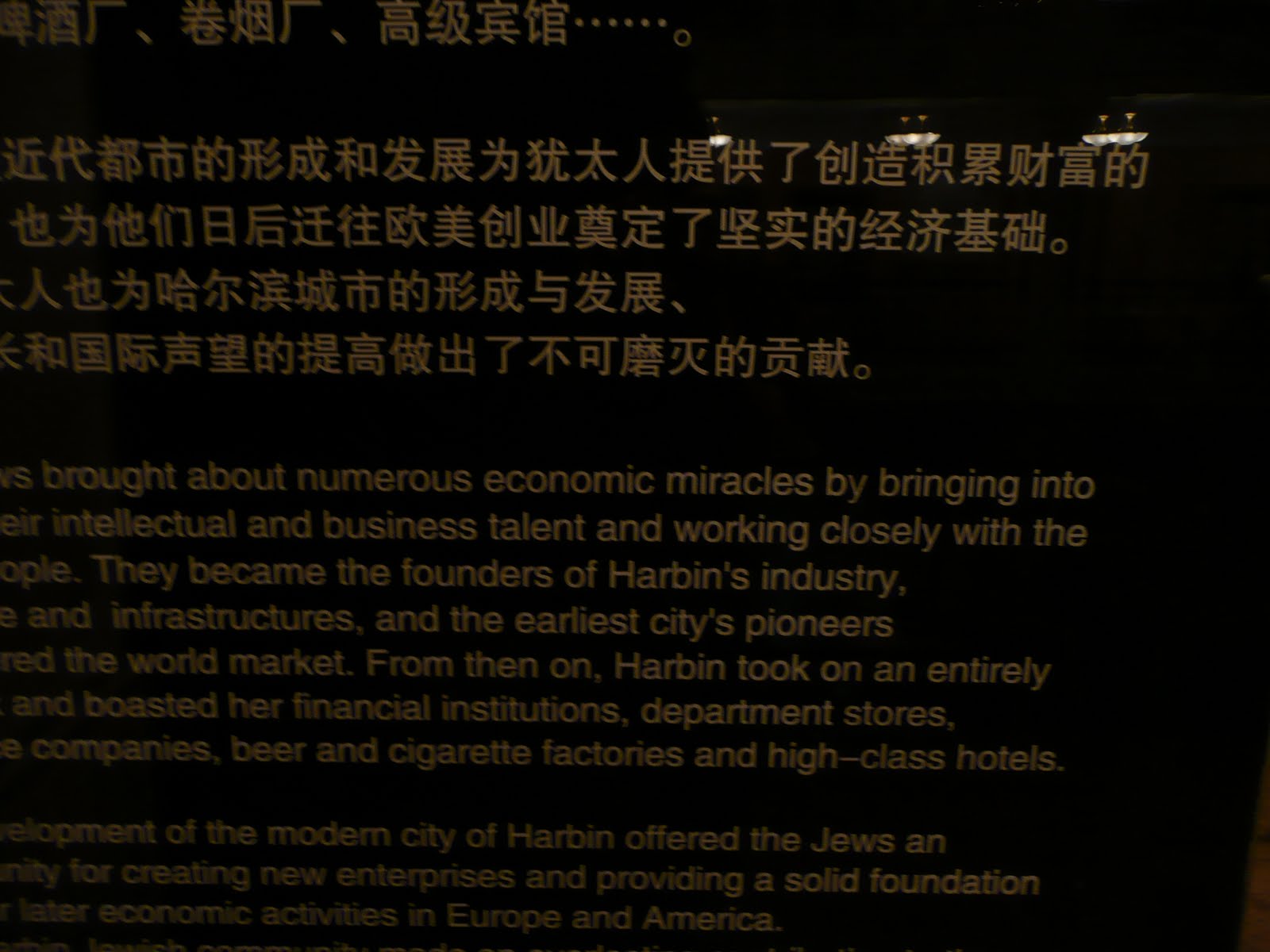
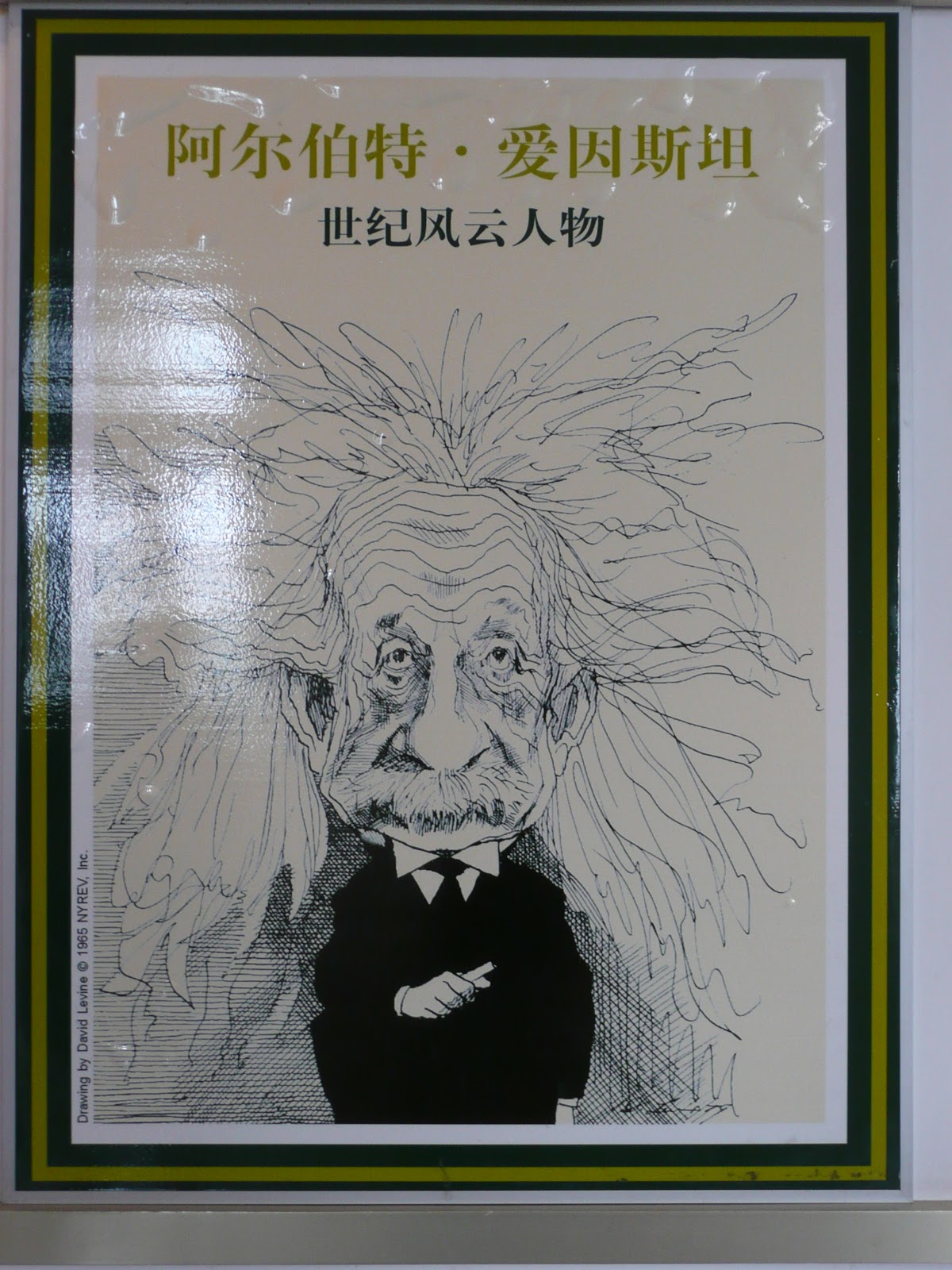
  • Last weekend I went to the Jewish quarter with two fellow Yalies. The quarter was really more of a single-building affair: the Jewish Museum. Inside the museum was split into three levels: the first floor with pictures and paintings of old Harbin (though they could have been of any city in China and some of them were definitely done in watercolors), the second floor of actual information (mostly facts about how nice the Chinese were to the incoming Jews), and the third floor made up of a wall of famous Jews (Einstein to Oppenheimer to Spielberg to Olympian Mark Spitz) and an assortment of Jews who had at one point or another come to Harbin. The museum was interesting in itself, not because of the factoids, but due to the very Chinese approach of self-congratulation while talking about something else.

The outside of the Jewish Museum.
Entrance plaque.
A photo of a meeting from the early 20th century taking place in the museum.
Jews arriving in Harbin. Apparently the Chinese were very, very nice.
Here's a reminder of what this museum is all about.
Here's another (Star of David).
Some of the captions were hilarious. This one describes how the Harbin Jews were "very choosy" about their living room displays.
In the West, Jews are stereotyped for being good with money. In Harbin, Jews work "economic miracles".
Note: none of these hundred or so people had ever visited Harbin. I actually doubt any of them had ever heard of it.
Water-bikes!!
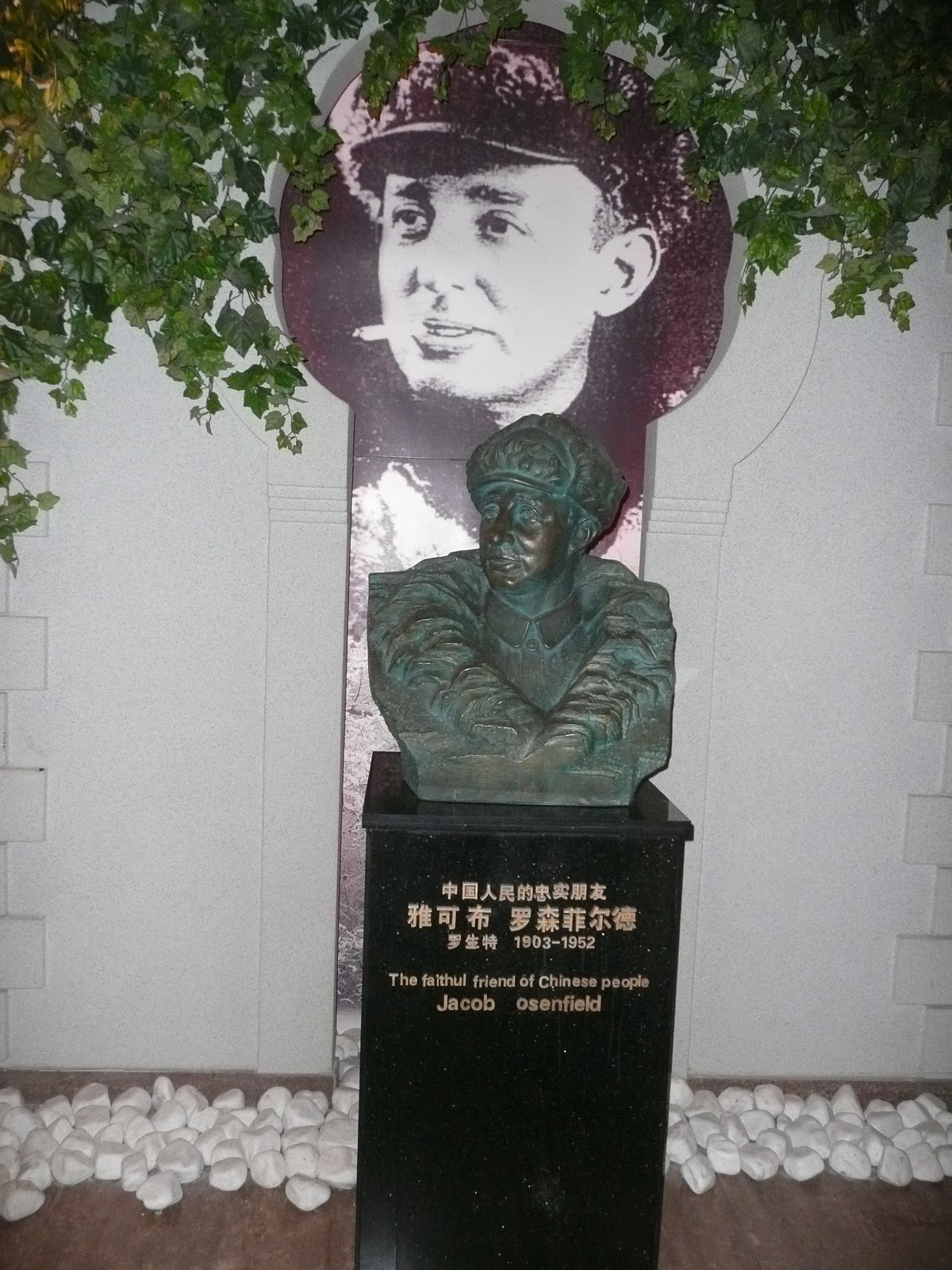
Dr. Joseph Rosenfeld helped out the Chinese Army during the 1940's and 1950's by performing life-saving surgeries. I kind of want to be him.
You really can't make this stuff up. Caption reads: "When Xenia Steingard was young and dead in 1939".
Einstein had a little shrine behind a staircase on the way out of the museum. There may or may not have been a word or to about knowledge in his hair.

Tonight I give a five minute presentation on the Rural Chinese Healthcare system to a panel of teachers before cramming for my three finals on Thursday and Friday. Less than a week left in China!

魏德

Saturday, July 30, 2011

Post the Fourteenth: Robots (Dandong 4 of 5)

Continued from Part III...

Downtown Dandong

Part IV: The City of Dandong

Just like any other city in China, Dandong is a bustling metropolis (see TOO MANY PEOPLE) full of chain stores and small shops alike. The thing about Dandong is while it is much less internationalized and developed than Harbin it still manages to be somewhat cleaner and friendlier. Even two weeks later, I'm still not sure why.

View of downtown Dandong from the Korean War Museum.
A view of the mountains from the Korean War Museum.
After the museum, we went to Dandong''s pedestrian street (apparently every major city in China has to have one area where people can walk around and shop for overpriced goods) to look around. It was sort of a poorer imitation of Beijing's Wangfujing or Harbin's Zhongyang Dajie, though just as lively. The typical banks and foreign stories were there, as well as cheaper Chinese imitations of said foreign stores. The street is home to one of the best bubble tea stands in China. For four kuai (about 60 cents), you could get one of 50+ flavors of milk tea with tapoica pearls. DELICIOUS.

Length-shot of Buxing Jie, Dandong's pedestrian street.
Another shot of Buxing Jie.
Yes, it's totally normal to wear one's jeans on one's head.
Even superheroes weren't spared by the economic recession.
Zhen Ai, or Real Love, is a nightclub in Dandong. The only reason that it's cool is due to the fact that it has a spring-loaded dance floor.
For dinner on Friday, we decided to check out the Pyongyang North Korean Friendship Restaurant in Dandong. The establishment was built by the North Korea government as a diplomatic bridge between China and North Korea. The restaurant itself is run by a team of North Korean androids waitresses and a lone North Korean director computer programmer manager. It's a bit odd since there aren't any windows, only half the tables are ever full and the place is unnervingly clean (compared to the dirt and grit outside on the street).  The waitresses are all naturally slim and gorgeous (North Korea obviously doesn't have any malnourished ugly people) and most of them can't speak Chinese.

They can't speak Chinese.

Each waitress, who is probably the daughter of some North Korean political big-shot, gets to come to China to work in the restaurant for a maximum of two years. Prior to coming to China, the women do not receive any Mandarin lessons. I'll tell you right now that trying to communicate to someone in a language that neither of you speak is one of the most frustrating things ever.

Anyways, back to the story...

When our (obviously American) party of six strolled into the restaurant, we were immediately greeted by a non-smiling young woman who led us to a table (with four seats) and left us to pull up two more chairs. Another young woman (also emotionless) stepped forward with a menu and stood by silently while we pursued about 20 pages of overpriced Korean fair. Besides dog meat, we had no idea what to get so I turned to the woman and asked her, in Chinese, to recommend a few dishes. She just looked back at me. I asked again. She sort of shook her head and pointed at the menu. "But which things are good?" "Ummmmm..." We went back and forth in this manner for some time, and eventually ended up pointing at the most tasty looking pictures. Our waitress said nothing at all, though she semi-pursed her lips when we ordered the dog meat. While the food was okay, the fengshui was a bit creepy so we quickly paid our bill (I had to ask about three times since she didn't understand me) and went down the street to an open-air barbecue restaurant for dumplings and meat kebabs.
Entrance to the China-North Korea Friendship Restaurant. Notice the blinds are closed.
The presentation seemed almost half-hearted. It's not like it's the only flagship outlet of North Korean cuisine and culture or anything.
Some kimchi, some Korean beef, and some dog meat. Stringy and plain, do not eat.
The restaurant was definitely a weird experience and left me with a lot of questions. Do the waitresses ever go out? What do they think of their Chinese customers? Of their American customers? What happens when they go home to the DPRK? After living for two years in China were there are loud advertisements, cell-phones, and South Korean pop music, do they want to go back?

End Part IV...

Tuesday, July 5, 2011

Post the Seventh: Does Not Translate

Hello again!

The end of last week saw a spike in work/tests/quizzes, hence my absence. Do not fret, however, since I've got some pictures to share! Also, some things:
  • This weekend CET took us to Sun Island ( 太阳岛 , taiyang dao), which given the weather was anything but sunny. The sky oscillated between grim & drizzly and morosely cloudy - until we left, that is, when suddenly the sun came out in all it's glory. Two friends and I still managed to enjoy our time on the island by playing in Naive Bear Park.
Literally, Stupid Bear Playground. Sounds fun, no?
An odd perversion of Bambi.

In reality, these things would probably not be friends.

Double-decker merri-go-round!

A cute little walkway thing by a lake. This place was filled with about six or so brides all getting their pictures taken.
  • Last week, my two Sun Island companions and I discovered a lovely street near campus filled with fruit and vegetable stands, outside restaurants, and a random assortment of stalls selling cleaning supplies, school supplies, etc. One of the restaurants has the best variety of meat and vegetable dishes I've seen in China as all are delicious. The other restaurant, while failing to compare in food quality, has better service and has kao bing ( 烤饼, fried bing). For those of you who don't know what bing is, there really isn't an explanation for it. It's sort of bread but sort of cake and also sort of a tortilla thing. It also varies in appearance, consistency, and make-up depending on what it comes with. You really just have to eat it in order to understand it.
On the left, beef-on-a-stick. On the right, kao bing. (Sorry there's a bit missing - I was hungry).

Hot Dog Dog says "Enjoy Freedom!
  • Corollary to the previous bullet point, Harbin really isn't Beijing. This difference was evidenced today by a physical fight taking place in our restaurant. Three friends and I arrived at the kaobing place and were about to order food when the fight actually began. It is suspected that a patron a) insulted the restaurant owners and/or b) refused to pay his bill, thus ensuing the conflict (nobody seemed to understand was happening except for the two actually throwing punches). Naturally, we retreated across the street and, like everyone else (including passing cars/taxis/bicycles), watched as the two men fought and eventually took their disagreement elsewhere. Unclear of the condition of either man. What was clear was that the Chinese way of staying out of conflicts that don't directly impact you was in effect. At no point did anyone intervene on either man's behalf (except for the restaurant boss who told them to leave the premises out of fear they would destroy his establishment). Nobody summoned the police (though unclear if they would have been of any use). People simply stopped their goings-on and watched the conflict unfold and, when it moved off, went about their business. I am unsure how I feel about that. Part of me thinks that this would never happen in the US - surely someone would intervene. Or would they? In NYC, would people stop? Or walk brusquely by to catch their subway?

More to come later!

魏德

Monday, June 27, 2011

Post the Sixth: Totally Looks Like...

First things first: today is Monday. Monday is apparently drain the sewage from the pipes day at Harbin Institute of Technology. All day there have been huge tank-bearing trucks parked alongside the roads. As soon as one of these trucks pulls up to a manhole, all conversation in the vicinity ceases and people literally book it out of there. The workers waited until about 8PM to handle the drain in the parking lot outside our dorm. I can tell you that the stench is DELIGHTFUL and makes an excellent study aid.

Anyways...

I've been thinking a lot about Chinese characters lately. A LOT. Probably because I have a million of them to learn every night. In order to expedite memorization, I've begun employing one of my favorite study strategies: character pictionary.

Chinese characters are a form of phono-semantic compound; they symbolize physical objects and abstract ideas through the addition of a determinative radical (which supplies meaning) to a rebus building-block character (which supplies sound). Traditional Chinese characters, with their deliberate strokes and overall structure, look quite similar to the things they represent. Unfortunately, the simplification of the Chinese writing system, while making my job here in Harbin easier (as well as increasing literacy in a country of over 1.4 billion people), has stripped some of the characters of that quality. I've still managed, however, to find other characters that adhere to their phono-semantic origins. I wanted to share some examples with readers back home (aka my parents) who don't necessarily speak Chinese:
  • 宿舍 (sùshè) – dormitory; the first character is composed of 百 (băi, hundred) and 人 (rén, person), which makes sense: a hundred people living together under one roof.
  • 怀孕 (huáiyùn) – to be pregnant; the second character 孕 (yùn, pregnancy) has a little 子 zĭ-child being born from the B-shaped-mother-thing (it actually means "to be" and the first character means "bosom" so I guess "the child of the bosom"?)
  • 好 (hăo) – good; the character is composed of 女 (nǚ, female) and 子 (zĭ, child), which should be obvious since a woman plus her child is good. Credit to my high school Chinese teacher for this one.
  • 串 (chuàn) – 1) to string together, 2) a cluster, 3) meat kebab; this character is composed of two things speared on a stick. Any questions?
  • 门 (mén) – door; no explanation needed, just walk through it and try not to get hit by the falling brick on the top left corner.
  • 楼 (lóu) – building/floor; this is one of those characters that you just sort of have to come up with your own way to remember it. 木 (mù), 米 (mĭ), and 女 (nǚ) combined translates to wood-rice-woman and obviously refers to a building, right?
  •  率 (lǜ) – rate or ratio; When I first encountered this character, I didn’t think I would ever be able to master it. Then I realized the little dot things look like the falling numbers from the Matrix movies. The Matrix is all about a computer code generating an alternate reality. Computer codes use numbers to encode information. Numbers are used to measure things and make comparisons. These measurements and comparisons translate to rates and ratios. Phew.
  • 腐败 (fŭbài) – corruption; this is one of my favorites. I like to think that it’s derived from the character 政府 (zhèngfŭ, government). You’ll notice that the bottom part of the first character features a 肉 (ròu, meat). Translation: if your government would rather sit on a bunch of meat than eat it or give it to the needy, it’s probably corrupt.

I should really write my own textbook. In the mean time, back to the books!


魏德

Monday, June 20, 2011

Post the Fourth: Tingbudong

"我发誓为了在CET哈尔滨项目中提高我的中文水平从现在开始到这学期结束我只讲汉语,同时我也会帮助我的同学遵守这个誓言."
~ CET Harbin Language Pledge

So it begins. The language pledge. What were once lively conversations have since become crippled exchanges between groups of CET students looking at each other over their mountains of homework. Slowly, a conversation (in Chinese!) will begin, developing promisingly as those involved gradually become more invested and more confident in their language abilities, people excited now that they are able to amply express themselves and their opinions, the conversation increasingly fluent as words begin to flow quickly and without bounds...until someone utters the lethal "tīngbudǒng" (听不懂, I auditorily don't understand you) and suddenly silence descends.

From now on I am only allowed to speak English to my American family. Outside of that, this blog will be my only English outlet for the summer. FDJGKDFGOSFFFJDKGS.

Some things:
  • I met my Chinese roommate! His name is Zhang Chiye and he is a second year electrical engineering (see AWESOME) student at the university. At first I was afraid that conversation might be awkward (given my language ineptitude), but things are actually great. His background story is a little sad since he, like so many Chinese people, was forced into his major due to the 高考 (massive life-determining college entrance exam that makes the SATs look like a game of go-fish) but he's somehow managed to not be bitter about it. In fact, he's hilarious.
The pillow doesn't really do him justice but it is a good representation of his sense of humor.
  • Who do I need to talk to about the weather? Harbin is essentially in Russia, yet it is still very hot here (though nights are cool). Unclear how anything gets done during the day in Chinese universities when there isn't any air conditioning and one has just had a large bowl of 榨菜肉丝炒饭, otherwise known as hot-pickled-mustard-tuber (don't laugh) meat fried rice.
Doesn't that look delicious?
  • Yesterday we had lunch with our 1-on-1 professors who will help us with our 8-week long research project. Mine is Sui laoshi, a 50-something preventive medicine (预防医学) researcher-type person who focuses on "top priority easily transmittable diseases" like TB, H1N1, and AIDS (艾滋病 in case you were curious). She is another victim of the 高考, as well as conservative parents who apparently didn't think civil engineering/architecture, which are very desirable majors, was very becoming for a young Chinese woman. So now she tries to protect unsuspecting villagers from contracting AIDS. The amount of knowledge inside her head is almost frightening; this woman can tell you something about almost any aspect of the Chinese health-care system from preventive medicine to medical distribution to health insurance policy differences between regions of China. Tomorrow is our first legitimate class so I'm planning on reading (thanks, Wikipedia/Google) about the health situation in China for preparation.
  • Outside of the 1-on-1 topic, I have three other classes: 1-on-2 drill class, composition, and business Chinese. The 1-on-2 consists of two students and one teacher; the students recite dialogues and discuss topics while the teacher leads the discussion and mercilessly corrects pronunciation and tone mistakes (huáshèngdùn...huáshèngdùn...huáshèngdùn...). Composition class is focused on written Chinese, which differs from spoken Mandarin in both grammar and vocabulary; students study a variety of styles and imitate them to learn how the Chinese put down thoughts and feelings on paper. Business Chinese is exactly what is sounds like. I'm not sure why I'm taking this last class as I studied economics for three semesters at Yale and have hated them all, both individually and together as a whole, though the chapters on medical insurance and environment look pretty good. Vocabulary words like "welfare and remuneration" (福利待遇) and "focused strategic management" (专营主业战略管理) aren't helping. Whatever, no pain, no gain.
Hopefully classes will become less hectic and we students will be able to do something other than homework. For now, thunderstorm! Update to hopefully come later this week!

魏德